

The History and Evolution of the Mobile Phone
Few inventions have reshaped daily life as thoroughly, or as quickly, as the mobile phone. In barely half a century, it has moved from a bulky, expensive novelty carried by a handful of business executives to a device that more people on Earth now own than have access to reliable electricity or clean drinking water. Understanding how the mobile phone evolved from a car-mounted radio telephone into the pocket-sized computer most people now carry everywhere offers a window into one of the fastest technological transformations in human history.
The First Call
The mobile phone’s origin is often traced to April 3, 1973, when Motorola engineer Martin Cooper made the first handheld cellular phone call, reportedly to a rival researcher at Bell Labs, using a prototype that weighed over a kilogram and offered barely twenty minutes of talk time before needing a lengthy recharge. It would take another decade before Motorola brought a commercial handheld cellular phone to market, in 1983, at a price equivalent to several thousand dollars today, putting it firmly out of reach for all but the wealthiest early adopters.
These first-generation, or 1G, mobile networks relied on analog signals and offered limited capacity, poor call quality by modern standards, and minimal security, since calls could sometimes be intercepted with relatively simple radio equipment. Despite these limitations, the mobile phone’s core promise, the ability to make and receive calls without being tethered to a fixed location, was compelling enough to drive rapid investment in the underlying network infrastructure throughout the 1980s.
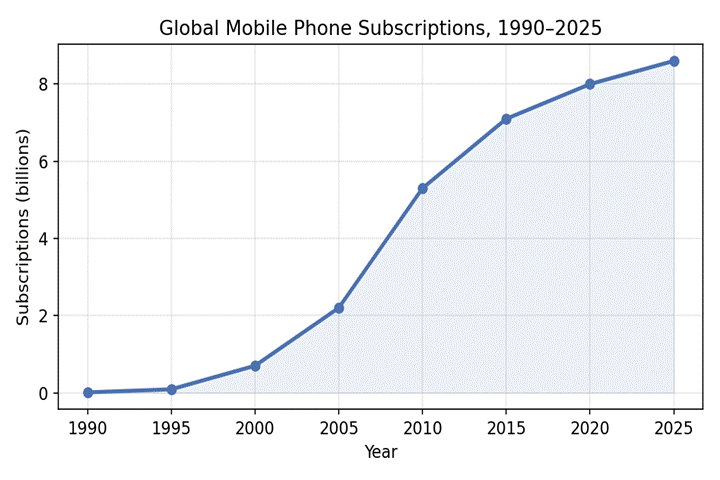
Figure 1: Global mobile phone subscriptions from 1990 to 2025, tracking the device’s journey from rarity to ubiquity.
From Digital Networks to Ubiquity
The shift to second-generation, or 2G, digital networks in the early 1990s marked a major turning point, improving call quality and security while also introducing a feature that would prove unexpectedly transformative: the text message. Short Message Service, or SMS, was originally conceived as a minor add-on feature for network engineers, but it quickly became an enormously popular way for ordinary users to communicate, particularly among younger users, laying early groundwork for the text-based communication habits that would later define smartphone use.
Throughout the 1990s and early 2000s, mobile phones became progressively smaller, cheaper, and more capable, adding features such as basic games, ringtone customization, and simple cameras. Nokia, in particular, became a dominant global brand during this period, known for durable, reliable handsets that helped drive mobile phone adoption rapidly across both wealthy and developing markets, in some cases allowing regions with limited fixed-line telephone infrastructure to leap directly to mobile connectivity.
The Smartphone Turning Point
While earlier devices such as IBM’s Simon and various Palm and BlackBerry devices had already begun blending phone and computing functions during the 1990s and early 2000s, the launch of Apple’s iPhone in 2007 is widely regarded as the moment that redefined what a mobile phone could be. By combining a touchscreen interface, a capable mobile web browser, and later an app ecosystem into a single, tightly integrated device, the iPhone established a template that the rest of the industry would largely follow. Google’s Android operating system, launched shortly afterward and adopted by a wide range of manufacturers, extended smartphone capability to a much broader range of price points, accelerating global adoption considerably.
A Device That Absorbed Countless Others
Part of what makes the smartphone’s rise so remarkable is how thoroughly it absorbed the functions of numerous previously separate devices. The camera, the music player, the GPS navigation device, the alarm clock, the calculator, the flashlight, and eventually much of the personal computer’s core functionality were all steadily folded into a single pocket-sized device over the course of roughly fifteen years, a pattern of technological convergence that has few precedents in consumer electronics history.
A Global, Uneven Transformation
Today, mobile phone penetration exceeds the total human population in many countries, a reflection of the fact that many people now own multiple devices or subscriptions. Yet access remains far from evenly distributed; while smartphone ownership is nearly universal in wealthy nations, a meaningful share of the global population, particularly in parts of rural Africa and South Asia, still relies on more basic feature phones or has no mobile phone access at all, a gap that has significant implications for education, financial inclusion, and access to information that later articles in this series will explore in more detail.