

The Smartphone Camera Revolution
Perhaps no single feature has transformed smartphones as dramatically, or as visibly, as the camera. What began as a novelty add-on capable of capturing grainy, low-resolution images has evolved into a sophisticated imaging system that has fundamentally changed how billions of people document their lives, consume news and entertainment, and even conduct scientific and medical work. The smartphone camera’s rapid evolution offers a compelling case study in how a secondary feature can eventually become one of a product category’s most important selling points.
Humble Beginnings
The first commercially available camera phone, released in Japan in 2000, offered a resolution of just 0.11 megapixels, producing images barely suitable for anything beyond the smallest thumbnail display, and was initially viewed by much of the industry as a minor novelty rather than a meaningful feature. Early camera phone images were frequently mocked for their poor quality compared to dedicated digital cameras of the same era, which offered dramatically better resolution, lens quality, and manual controls.
Despite this rocky start, camera phones caught on quickly, driven less by image quality than by sheer convenience: unlike a dedicated camera, a camera phone was a device people already carried everywhere, making it available to capture spontaneous moments that would otherwise have gone entirely undocumented.
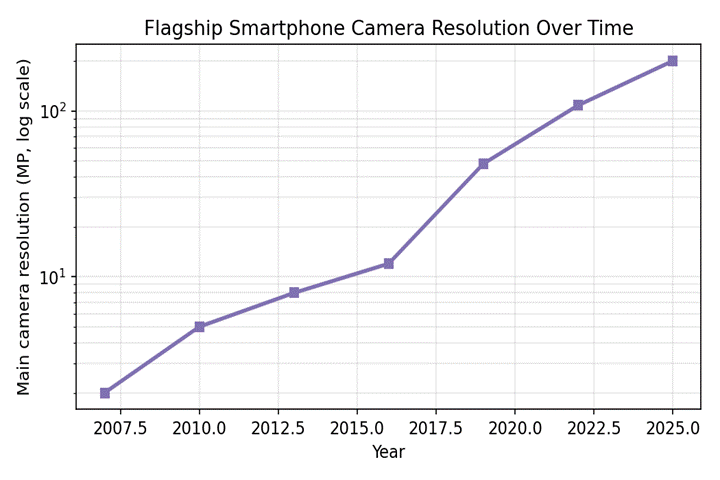
Figure 4: Flagship smartphone main camera resolution over time, shown on a logarithmic scale to capture the dramatic multi-generation increase.
The Megapixel Race and Its Limits
For much of the 2000s and early 2010s, smartphone camera marketing centered heavily around megapixel counts, as manufacturers competed to offer ever-higher resolution sensors. This race eventually ran into diminishing returns, since resolution beyond a certain point, particularly on the small sensors that fit within a smartphone’s thin body, does not meaningfully improve image quality and can actually worsen performance in low light conditions, where smaller individual pixels capture less light each. This led manufacturers to shift their engineering focus toward other factors with a greater impact on real-world image quality, including sensor size, lens aperture, and, increasingly, computational processing.
Computational Photography Changes the Game
The single biggest shift in smartphone camera capability over the past decade has arguably come not from hardware alone but from computational photography, the use of software algorithms, often powered by machine learning, to process and enhance images well beyond what the raw sensor data alone would produce. Techniques such as multi-frame noise reduction, which combines several rapidly captured images into a single cleaner result, and computational Night Mode features, which allow smartphones to capture dramatically better low-light images than their small sensors would otherwise permit, have allowed smartphone cameras to compete credibly with dedicated cameras that have significantly larger sensors and more capable optics.
Portrait mode features, which use software to simulate the shallow depth-of-field background blur traditionally achieved through expensive, large-aperture lenses, represent another prominent example of computational photography substituting software cleverness for hardware limitations, often combining data from multiple camera lenses or dedicated depth sensors to identify a subject and process the background separately.
Multiple Lenses and Specialized Sensors
Modern flagship smartphones typically include multiple rear camera lenses, each optimized for a different purpose, commonly a standard wide lens, an ultra-wide lens for capturing a broader field of view, and a telephoto lens for optical zoom, allowing users to shoot a much wider range of scenes effectively than a single fixed lens would permit. Some devices have added dedicated macro lenses for extreme close-up photography or specialized sensors for capturing depth information used in augmented reality applications, further expanding the versatility of the smartphone as an imaging device.
Broader Cultural and Economic Impact
The smartphone camera’s rise has had effects reaching well beyond personal photography. It has been a significant factor in the growth of social media platforms built around visual content, transformed photojournalism by putting a capable camera in the hands of ordinary bystanders who frequently capture breaking news events before professional journalists arrive, and has substantially disrupted the traditional standalone digital camera market, which has seen unit sales decline dramatically since smartphone cameras became broadly capable enough to satisfy most casual users’ needs. Dedicated cameras remain preferred among professionals and enthusiasts for their superior optics and manual control, but for the vast majority of everyday photography, the smartphone camera has effectively become the default tool for a large majority of the world’s population.