

5G, Foldables, and the Future of Mobile Phones
After more than a decade in which smartphone design settled into a fairly predictable pattern, a rectangular glass slab with a large touchscreen, the mobile phone industry has recently entered a period of renewed experimentation, driven by advances in network technology, display engineering, and artificial intelligence. Looking at where these trends are headed offers a useful sense of how the mobile phone, already one of the most transformative devices in modern history, may continue to evolve in the years ahead.
5G and the Next Generation of Connectivity
Fifth-generation, or 5G, mobile networks represent a substantial upgrade over previous generations, offering significantly faster data speeds, lower latency, and the capacity to support many more connected devices simultaneously within a given area. While early 5G marketing often emphasized faster download speeds for streaming and gaming, some of the technology’s more significant longer-term implications lie in enabling new categories of connected devices and services that require the low latency and high reliability 5G can offer, including more responsive augmented reality applications, remote-controlled machinery, and expanded Internet of Things device networks.
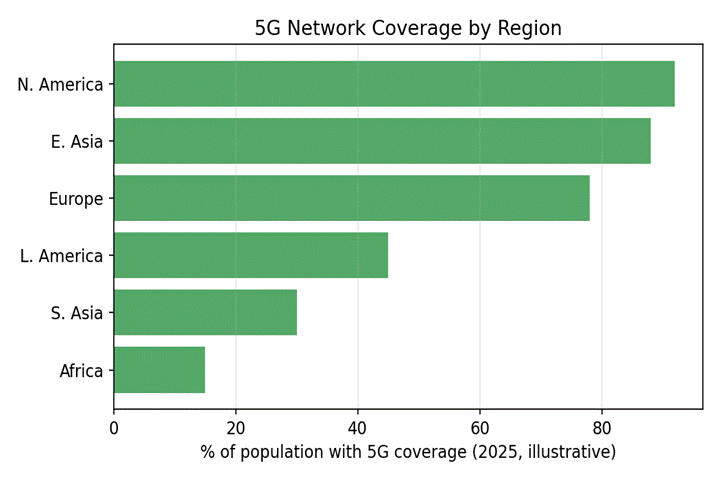
Figure 5: Illustrative 5G network coverage by world region, highlighting the substantial gap between wealthy and developing markets.
Uneven Rollout Across the Globe
Despite years of deployment, 5G coverage remains highly uneven across the world, with wealthy nations in North America, East Asia, and Western Europe generally offering substantially broader coverage than much of Latin America, South Asia, and particularly Africa, where infrastructure investment costs and lower average consumer spending power have slowed rollout considerably. This uneven deployment mirrors a broader, longstanding pattern in mobile technology access, in which the newest capabilities tend to reach wealthier markets years, sometimes many years, ahead of lower-income regions, a gap with real implications for digital access and economic opportunity in the interim.
The Return of the Foldable Phone
Foldable smartphones, which use flexible display technology to allow a device to fold into a more compact form or unfold into a larger screen, represent one of the more significant hardware design shifts in the smartphone’s recent history, offering a genuine departure from the rectangular slab form factor that had otherwise remained largely unchanged for well over a decade. Early foldable devices faced significant durability concerns, including display creasing and hinge mechanisms prone to dust ingress and mechanical failure, issues that have improved considerably but not entirely disappeared across successive generations of hardware.
Foldables remain a comparatively small, premium segment of the overall smartphone market, reflecting their significantly higher price points and some lingering consumer uncertainty about long-term durability, but they have proven particularly popular in certain markets, notably South Korea and China, and continue to see steady year-over-year sales growth as the underlying technology matures and prices gradually decline.
Artificial Intelligence Moves Onto the Device
The integration of artificial intelligence directly into smartphone hardware and software represents perhaps the most significant current trend shaping the industry’s near-term future. Rather than relying entirely on cloud-based processing, newer smartphones increasingly include dedicated AI processing chips capable of running certain machine learning tasks directly on the device, improving both response speed and privacy, since sensitive data such as photos or voice recordings can be processed locally without necessarily being sent to external servers. On-device AI features now commonly include advanced photo editing capabilities, real-time language translation, and more capable voice assistants able to handle increasingly complex, multi-step requests.
Sustainability and the Question of Repairability
Growing environmental concern around electronic waste has pushed both regulators and consumers to pay increasing attention to smartphone repairability and longevity. The European Union has introduced regulations requiring manufacturers to make batteries more easily user-replaceable and to provide spare parts and repair documentation for a longer period after a device’s release, part of a broader ‘right to repair’ movement that has gained momentum in multiple markets. Some manufacturers have responded by extending software update support windows considerably, allowing phones to remain secure and functional for longer periods, reducing the pressure many consumers previously felt to upgrade devices every year or two primarily for security reasons.
A Device Still Being Reinvented
More than fifty years after that first handheld cellular phone call, the mobile phone remains a technology very much in active development, still absorbing new capabilities, still being reshaped by advances in network infrastructure, materials science, and artificial intelligence. Whether the coming decade brings another transformation as dramatic as the original shift from feature phone to smartphone remains uncertain, but the pace of change across connectivity, form factor, and on-device intelligence suggests that the mobile phone’s evolution, far from settling into a final, stable form, is likely to continue producing significant shifts in how people use these devices for years to come.